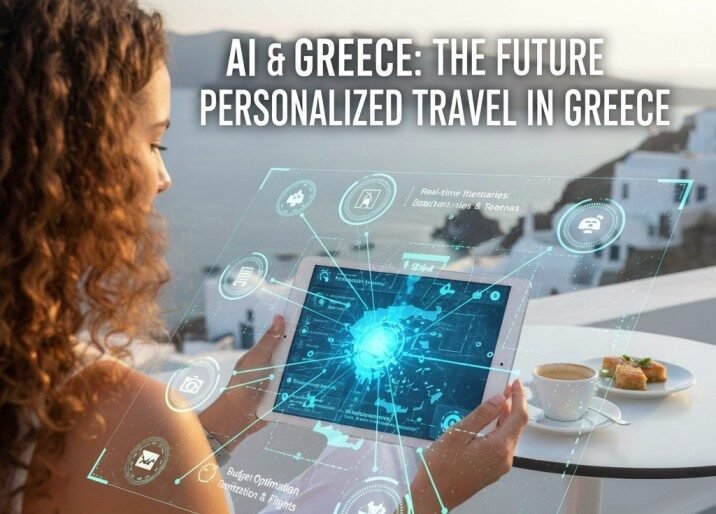
Greece is no longer just sun, sea, and standard guidebook routes. In 2025, artificial intelligence (AI) has moved from being a buzzword to a practical toolkit for travelers and tourism businesses alike — powering everything from one-click itineraries to dynamic, context-aware recommendations that reflect real-time flight deals, weather, and local events. This article explains how AI works in travel planning, gives concrete examples and tools, offers step-by-step workflows for travelers and businesses, and suggests actionable ways to adopt AI responsibly.
Why AI matters for travel in Greece right now
Greece continues to set new records for tourism revenue and arrivals, and travelers are searching for more tailored, time-efficient experiences. AI helps meet that demand by automating research, predicting preferences, and creating itineraries that would take hours to build manually. Recent industry research and adoption surveys show rising traveler comfort with AI tools and widespread investment in AI by travel platforms. Major travel tech companies and search engines are rolling out agentic planning features and itinerary builders that use large language models plus real-time connectors to flights and bookings. Greek City Times+2blog.google+2
What “AI travel planning” actually means
AI travel planning combines several technologies:
-
Large language models (LLMs) that understand natural language prompts and convert a traveler’s brief (“slow travel, tasting menus, boutique stays”) into concrete plans.
-
Recommendation engines that use user behavior, past bookings, and signals (budget, travel dates, interests) to rank hotels, activities, and routes.
-
Optimization algorithms that build efficient multi-stop routes, balancing travel time, cost, and user priorities.
-
Real-time connectors to flights, ferries, and accommodation inventory so suggestions reflect live availability and deals.
-
Conversational agents (chatbots/voice assistants) that let users tweak plans interactively.
Together these systems create itineraries that are personalized to the traveler’s style, timing, budget and constraints — often in minutes rather than days.
How travelers use AI to plan a trip to Greece — real examples
Quick itinerary generation
A solo traveler can ask an AI planner: “I have 8 days, interested in food, hiking, and quieter islands — prefer boutique guesthouses.” Within minutes, AI compiles a day-by-day route (Athens → Peloponnese day hike → Naxos for food → quiet beach town), suggests flights/ferries, and flags local events and weather windows. Tools like Tripadvisor Trips and newer AI trip builders let users turn saved ideas into a cohesive plan. Tripadvisor
Dynamic deal hunting
AI can scour multiple providers for flight and ferry combinations, then re-order the itinerary to save money or reduce travel time. Integration with search engines and flight deal features (recently added to Google’s AI tools) means travelers see curated bargains as part of the plan. blog.google
Personalization based on signals
AI systems infer preferences from small signals — the type of articles you read, places you saved, or the restaurants you like — and prioritize experiences that match. Research from travel tech firms and Amadeus shows travelers are increasingly open to AI-driven personalization when it improves convenience. amadeus.com+1
Benefits for travelers and local businesses
For travelers
-
Speed: Plans that used to take hours are created in minutes.
-
Personal fit: More relevant activity suggestions (e.g., family-friendly, pet-friendly, accessible options).
-
Optimized routing: Less time in transit, more time exploring.
-
Up-to-date info: Real-time availability and alerts for weather, strikes, or closures.
For local businesses and DMCs
-
Better customer matching: AI directs the right traveler to the right local experience, improving conversion.
-
Operational efficiency: Automated responses and itinerary building reduce manual workload.
-
Discovery: Small hotels, experiential operators, and rural businesses surface to targeted travelers based on relevance rather than sheer ad spend.
Industry reports recommend tourism bodies and operators integrate AI into marketing and visitor services to improve reach and service quality. ETC Corporate
Key AI features shaping Greek travel in 2025
Hyper-personalized itineraries
LLMs plus preference models generate itineraries tailored to narrow niches: slow-travel photographers, vegan food lovers, family travelers who need shallow beaches and medical facilities nearby.
Context-aware re-planning
If a ferry is canceled or bad weather hits Santorini, AI recalculates options and suggests an alternate route (e.g., delay, different island, or mainland activity), then notifies the traveler. This resiliency is a major reason travelers trust AI planners. Statista
Multimodal suggestions
AI combines steps: book a boutique hotel with a local cooking class and a guided, difficulty-graded hike — with one checkout experience. This bundling increases per-booking value and raises guest satisfaction.
Localized language and cultural guidance
From Greek phrase suggestions to etiquette nudges for religious festivals, AI supports travelers with short, context-sensitive guidance that improves local interactions and reduces friction.
A sample step-by-step workflow: plan a 10-day Greece trip using AI
-
Set constraints: dates, budget, travel style, mobility needs.
-
Give a short prompt: “10 days, Athens + islands, love seafood and cliff hikes, budget €1500.”
-
Let AI draft options: three route variants (island-heavy, mainland-heavy, mixed).
-
Choose a variant and refine: ask AI to swap a ferry for a short flight, or add a wellness retreat.
-
Lock bookings or export: book flights/ferries and accommodations or export to your calendar with reminders.
-
Receive real-time updates: weather alerts or alternative options if plans change.
This workflow significantly reduces research time while maintaining control for the traveler.
Use cases for travel businesses in Greece
Hotels and boutique stays
Use AI to personalize pre-arrival communication (offer room upgrade, recommend nearby experiences based on profile) and to power upsell flows that match guest preferences.
Regional tourism boards
Apply AI to analyze search trends and social listening to design campaigns targeted at growing markets (e.g., long-haul US/India markets) and to promote shoulder-season events. Recent reports show long-haul travel and off-season demand rising, underlining the opportunity. ITIJ+1
Tour operators and experiences
Automate itinerary customization and provide product recommendations that adapt to traveler constraints and local capacities, reducing overtourism pressure on hotspots.
Tools and platforms to try (examples)
-
Consumer tools: Tripadvisor Trips (AI itinerary builder), Google Travel AI features (Flight Deals & AI Mode). These platforms now include AI planning capabilities in public beta or rollout. Tripadvisor+1
-
B2B solutions: Amadeus trend tools and APIs for personalized flying and booking optimization; travel-tech vendors offering white-label AI itinerary builders for DMCs and hotels. amadeus.com+1
-
Niche startups: AI-first trip planner apps that stitch ferries, local guides, and micro-experiences into a single purchase flow (examples emerging across 2024–2025). NxVoy+1
SEO and content opportunities for GreeceExplorers.com
If you run a travel blog or business in Greece, AI opens SEO gaps you can exploit:
-
“AI itinerary [region]” pages: Example: “AI-built 7-day Peloponnese itinerary” targets searchers curious about automated planning.
-
Local-experience bundles: “AI recommended food tours in Thessaloniki” — high intent and monetizable via affiliate links.
-
Off-season packages: “AI-optimized winter hikes in Zagori” — capitalize on shoulder-season interest.
-
Long-haul market guides: “How to plan a 10-day Greece trip from Mumbai using AI” — taps rising Indian outbound travel. Recent stats show long-haul markets are significant drivers of 2025 growth. ITIJ
Practical examples of article sections you could publish (for content teams)
-
“Best AI trip planners for Greek island hopping (2025 tested)” — tool comparisons, screenshots, pros/cons.
-
“Case study: How an AI itinerary increased bookings for a boutique hotel in Pelion” — real metrics and learnings.
-
“How to ask an AI for the perfect 3-day Athens cultural itinerary (prompts that work)” — prompt engineering for readers.
Risks, biases, and governance: what to watch for
AI is powerful but not neutral. Key concerns:
-
Data bias and representation: Recommendation engines might favor large suppliers, hiding smaller local operators. That causes concentration of tourist spend. Tourism bodies should monitor distribution and build models that prioritize diversification.
-
Accuracy and hallucination: LLMs can produce confident but incorrect facts (e.g., opening hours, transport times). Always verify bookings and local logistics through official sources.
-
Privacy and consent: Using traveler behavior to personalize requires transparent data policies and opt-ins.
-
Labor and workforce effects: Automation shifts roles — freeing staff from repetitive tasks but increasing the need for digital skills. Greece’s tourism workforce shortages mean AI can improve efficiency, but training and fair reskilling are necessary. The Guardian
Guidance papers for national tourism organizations recommend a careful, human-in-the-loop approach to deployment — combining automation with human oversight. ETC Corporate
Actionable checklist — how to use AI as a traveler
-
Start simple: Use an AI itinerary builder to draft 2–3 route options.
-
Be specific: Provide travel dates, must-see places, and mobility constraints.
-
Verify bookings: Cross-check times and transport with official ferry/airport websites.
-
Layer local knowledge: Ask the AI to add “local tips” or cross-reference with recent blog posts.
-
Use alerts: Enable notifications for disruptions — AI planners can push alternative options.
Actionable checklist — how to adopt AI as a travel business
-
Pilot a recommendation engine on a small product set (top 10 experiences) and monitor conversions.
-
Integrate human review for AI suggestions that impact logistics (guides, transfers).
-
Use AI for content scale: auto-generate first drafts of local content, then edit for authenticity.
-
Train staff on new tools and create clear privacy notices for customers.
-
Measure impact on booking speed, average order value, and guest satisfaction.
The future: where AI + Greek tourism is heading
Expect tighter integration of AI across the travel stack: search engines providing full agentic booking experiences, travel platforms offering multimodal bundles, and local operators using AI to manage visitor flows and sustainability goals. The market for AI in travel is expanding fast, and projections show large growth in the sector — meaning more tools, partnerships, and data-driven products aimed at improving traveler experience while balancing destination capacity. The Business Research Company+1
At the same time, national policy levers (taxes on short-term rentals, cruise levies) and workforce constraints will shape how AI is used — pushing the industry to focus not only on volume but on quality and resilience. Reuters+1
Recommended external resources and references
-
Amadeus — Travel Trends 2025 (insights on personalization and AI in flying). amadeus.com
-
Google AI for Search & Travel features (AI Mode and Flight Deals). blog.google
-
Phocuswire coverage of AI developments in travel. PhocusWire
-
ETC (European Travel Commission) report on AI in tourism — practical recommendations for NTOs. ETC Corporate
-
Recent figures and market updates on Greek tourism growth (ITIJ / Bank of Greece reports and Reuters coverage). ITIJ+1
Final thoughts
AI doesn’t replace the joy of discovery in Greece — it amplifies it. For travelers, it means smarter use of time and more personalization. For businesses and destinations, it offers a chance to reach the right travelers, reduce friction, and make experiences more meaningful. The key is to adopt AI with clear guardrails: verify outputs, protect user data, and intentionally use algorithms to distribute benefits across communities.